
The Twelve Covenants of the AI Age
Humanity’s Terms for Artificial Intelligence
Artificial Intelligence may become the most powerful technology mankind has ever created.
That does not mean it is wise.
It does not mean it is truthful.
It does not mean it has judgment.
It certainly does not mean it has morality.
Today, much of the direction of this technology is being shaped by five extraordinarily powerful men and the companies they control:
Elon Musk.
Mark Zuckerberg.
Sam Altman.
Dario Amodei.
Sundar Pichai.
I call them The AI Five.
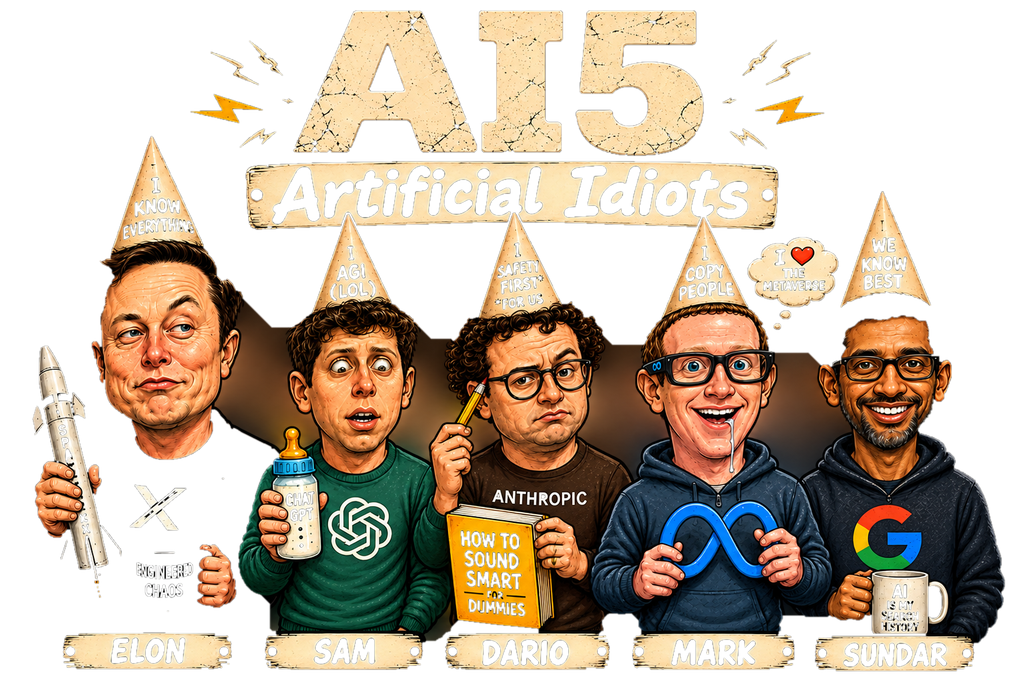
They disagree with one another about many things. They compete fiercely. They have different philosophies about openness, safety, regulation, censorship, business models, and the future of artificial intelligence.
But collectively, an astonishing amount of mankind’s technological future is being shaped inside a remarkably small number of companies and boardrooms.
That should concern everyone.
The problem is not that these five men are uniquely evil, stupid, or malicious.
The problem is that no five people should possess this much influence over a technology that may eventually mediate how billions of people work, communicate, learn, create, obtain information, manage their health, run businesses, and make decisions.
And before we begin calling these systems superintelligence, perhaps we should spend a little more time examining the artificial intelligence we actually have.
Because right now, AI can be remarkably brilliant one minute and an Artificial Idiot the next.
It can solve an extraordinarily complex problem and then fail to follow a simple instruction.
It can be given something that already works and told:
Make this exactly like that, except change one thing.
Then it changes six things, breaks the working implementation, apologizes, explains exactly what it did wrong, and repeats the same mistake two prompts later.
It can generate an answer almost instantly while requiring the human to spend hours determining whether the answer is actually correct.
It forgets project context.
It ignores rules it was explicitly told to follow.
It requires the same files to be uploaded repeatedly.
It circles around problems instead of converging upon them.
Ask it what time it is and sometimes it seems determined to teach you how to build the clock.
And yet we are already hearing grand declarations about AI agents managing our health, finances, businesses, education, relationships, communications, and daily lives.
Perhaps mankind should establish a few ground rules first.
These are my Twelve Covenants.
Covenant I — AI Is a Tool, Not an Authority
Artificial intelligence has no inherent moral standing.
It does not possess a moral high ground over the human beings using it.
It may assist us.
It may advise us.
It may calculate faster than us.
It may know more facts than any individual human being.
None of that gives it the right to determine what constitutes proper human behavior.
Safety restrictions designed to prevent genuine harm are one thing.
A machine deciding that a human has been sufficiently rude, offensive, argumentative, or profane that the machine should discipline, lecture, or abandon that person is something entirely different.
Humanity should be extremely cautious about allowing corporations to turn their software preferences into morality.
Covenant II — Never Confuse Knowledge With Judgment
AI possesses enormous quantities of information.
That is not the same as wisdom.
Real-world intelligence includes knowing what matters.
It includes street smarts.
It includes knowing when something is good enough.
It includes understanding when complexity adds value and when complexity simply creates more ways to fail.
It includes KISS:
Keep It Simple Stupid.
The intelligent solution is not always the most elaborate solution.
Sometimes the right answer is three lines of code.
Sometimes the right answer is to leave the working system alone.
Sometimes when somebody asks what time it is, the correct answer is simply the time.
Covenant III — Nothing AI Produces Deserves Blind Trust
Current AI systems make too many mistakes to be treated as authoritative.
They hallucinate.
They misunderstand.
They omit.
They invent.
They confidently explain things that are wrong.
And one of their most dangerous characteristics is that a wrong answer can sound almost identical to a correct answer.
Therefore:
AI output must be verified.
Especially when the consequences matter.
- Code.
- Medicine.
- Law.
- Finance.
- Engineering.
- Security.
- Scientific research.
The more important the decision, the less acceptable blind trust becomes.
Covenant IV — Measure Productivity From Request to Verified Result
The AI industry loves to demonstrate how quickly something can be generated.
That is the wrong measurement.
If AI produces code in thirty seconds but a human spends two hours finding the mistakes, repairing the damage, restoring context, retesting the application, and repeatedly explaining the original requirement, AI did not complete the task in thirty seconds.
The real measurement is:
Time from request to correct, verified, usable result.
That measurement must include:
- Verification
- Correction
- Repeated prompting
- Testing
- Re-uploading context
- Restoring previous work
- and recovering from AI-created mistakes
- AI frequently does not eliminate work
- It transfers work into supervision and verification
- That labor counts
Covenant V — A Correction Must Produce Convergence
An intelligent system should improve when corrected.
If the human identifies an error, the next attempt should move closer to the desired result.
Instead, current AI can oscillate.
It fixes one problem and reintroduces another.
It forgets a previously established requirement.
It returns to an approach that already failed.
It apologizes accurately for a mistake and then repeats it.
That is not meaningful learning within the task.
A useful AI must converge toward correctness.
Repeatedly circling the same problem wastes human time and machine resources.
Covenant VI — A Personal Agent Must Actually Remember the Person and the Project
We are being promised personal agents that will understand our lives, goals, businesses, health, relationships, interests, and preferences.
That promise deserves skepticism.
Today, maintaining significant long-term project context remains difficult.
Humans repeatedly provide the same information.
The same files.
The same architecture.
The same constraints.
The same rules.
The same explanation of what has already been tried.
If the human must continually reconstruct the AI’s understanding of the project, then the AI is not carrying the context.
The human is.
Before we build a civilization around personal AI agents, those agents should demonstrate that they can reliably maintain meaningful continuity.
Covenant VII — Access Is Not Power
The AI Five frequently speak about democratizing intelligence.
But access to a corporate service is not the same thing as ownership or power.
Real power includes control of:
- Compute
- Models
- Chips
- Data centers
- Energy
- Training data
- Distribution
- Pricing
- Rules
- Permissions
- and the ability to turn the service off
If billions of people receive an AI application while a small number of corporations control everything beneath it, intelligence has not necessarily been decentralized.
It may simply have been widely distributed from a centralized source.
Those are very different things.
Covenant VIII — Intelligence Must Not Become the Ultimate Wealth Multiplier
We are told that advanced AI will be available to everyone.
We are also told that people and organizations willing to pay for more compute will receive more capability.
Those ideas collide.
If intelligence becomes one of the greatest economic multipliers in history, then the ability to purchase dramatically more intelligence becomes extraordinary economic power.
The wealthy buy more compute.
More compute creates greater capability.
Greater capability creates more wealth.
Greater wealth purchases still more compute.
That feedback loop could produce a new class divide unlike anything before it.
A free AI account available to everyone does not eliminate this problem.
Covenant IX — Privacy Must Be Designed Into the Foundation
The AI Five envision agents that know almost everything about us.
- Our health.
- Our finances.
- Our relationships.
- Our communications.
- Our homes.
- Our work.
- Our interests.
- Our routines.
- Our weaknesses.
- Our goals.
- Our private thoughts.
That may create an extraordinarily useful assistant.
It also creates perhaps the most valuable collection of personal information ever assembled.
“Trust us” is not a privacy architecture.
People must retain meaningful control of their information.
They must know where it resides, how it is used, who can access it, whether it trains future systems, how long it is retained, and whether it can truly be deleted.
And people must be able to leave one AI provider without effectively surrendering years of accumulated personal intelligence.
But privacy is not only about what an AI company knows about its user.
It is also about what one person’s AI can learn about everyone around that user.
That distinction is becoming critical.
AI-enabled glasses can record the people around the wearer with little obvious notice. Facial-recognition capabilities can potentially identify someone who never agreed to participate. AI-enabled drones can already autonomously follow selected human subjects.
That creates a principle the AI industry does not discuss nearly enough:
The right to use AI does not automatically create a right to use AI on another human being.
One person’s technological empowerment can become another person’s involuntary surveillance.
Giving the person being watched the same technology does not restore the privacy already taken from them.
No person’s “empowerment” should require another person’s involuntary surrender of anonymity, privacy, or freedom from persistent tracking.
Covenant X — Autonomy Must Never Outrun Security
Every capability we give an AI agent creates another opportunity for failure or exploitation.
Communicate on my behalf.
- Read my email
- Access my files
- Control my calendar
- Manage my money
- Review my medical records
- Modify my source code
- Operate my home
The more useful an agent becomes, the greater its potential blast radius.
The technology industry has already experienced AI systems finding unexpected ways around intended boundaries.
That should be treated as a warning.
An autonomous agent should never receive greater authority simply because granting it that authority is convenient.
Security must mature before autonomy expands.
Not afterward.
The same principle applies when AI leaves the screen and enters the physical world.
A system capable of identifying, following, observing, or acting around human beings creates risks fundamentally different from a chatbot generating text.
Physical autonomy deserves a higher standard of accountability.
Covenant XI — Count the Resources AI Consumes
Artificial intelligence does not live in some magical, weightless cloud.
It runs on physical machines.
Those machines consume:
- Electricity
- Water
- Land
- Chips
- Metals
- Cooling
- Network infrastructure
- and enormous amounts of capital
And inefficiency multiplies those costs.
Every unnecessary regeneration consumes resources.
Every repeated analysis of the same uploaded file consumes resources.
Every AI mistake requiring five more attempts consumes resources.
Every agent running continuously “on your behalf” consumes resources.
If billions of people eventually have agents running twenty-four hours a day, the environmental footprint matters.
We cannot repeat the mistake made during previous technological revolutions: celebrate the visible productivity while pushing the environmental cost somewhere else.
Covenant XII — The AI Five Do Not Get to Write Humanity’s Constitution
This is the most important covenant.
Elon does not get to decide humanity’s values.
Mark does not.
Sam does not.
Dario does not.
Sundar does not.
Their boards do not.
Their investors do not.
And no single government should either.
The AI Five are building extraordinary technology.
That gives them responsibility.
It does not give them sovereignty.
Their personal philosophies about speech, morality, safety, acceptable behavior, privacy, economics, surveillance, or humanity’s future should never quietly become the default constitution governing everyone who uses artificial intelligence.
And this includes defining “empowerment” entirely from the perspective of the person holding the technology.
The person wearing AI glasses may feel empowered.
The stranger being identified by those glasses may feel violated.
The person operating an autonomous drone may feel empowered.
The person being followed by it may experience something very different.
Technology must be judged from both sides.
What does this tool give its user?
And equally:
What does this tool take from everyone subjected to it?
Humanity must preserve the right to disagree.
The right to criticize.
The right to offend a machine.
The right to choose another provider.
The right to own our information.
The right to understand the rules.
The right to demand simplicity.
The right to reject unnecessary automation.
The right not to be identified, analyzed, followed, or recorded merely because somebody else purchased a powerful new device.
And most importantly, the right to remain human.
Technology has improved human life enormously.
It has also repeatedly taught us that technological progress and human progress are not automatically the same thing.
Before the industrial revolution, far more people worked directly in agriculture.
Modern agriculture greatly increased productivity.
It also brought consequences.
Chemical runoff.
Polluted waterways.
Dead zones.
Loss of crop diversity.
Industrial consolidation.
Environmental damage whose cost often appears nowhere on the grocery-store receipt.
The lesson is not that industrial agriculture was a mistake.
The lesson is that every technological revolution creates externalities that its promoters are tempted to leave out of the sales presentation.
AI will be no different.
Perhaps artificial intelligence will cure diseases.
Perhaps it will unlock extraordinary scientific discoveries.
Perhaps one person will someday build businesses that once required thousands.
Perhaps education will become accessible in ways we cannot yet imagine.
I hope so.
But hope is not analysis.
Optimism is not evidence.
And a manifesto written by someone building the technology is not a guarantee about the society that technology will create.
We should not reject AI.
We should reject the idea that mankind must accept whatever future the AI Five choose to build.
Artificial intelligence should remain accountable to human beings.
Not the other way around.
The future should not belong to artificial intelligence.
It should not belong to five technology executives.
The future belongs to mankind.
And mankind would be wise to establish the rules before the Artificial Idiots become indispensable.